
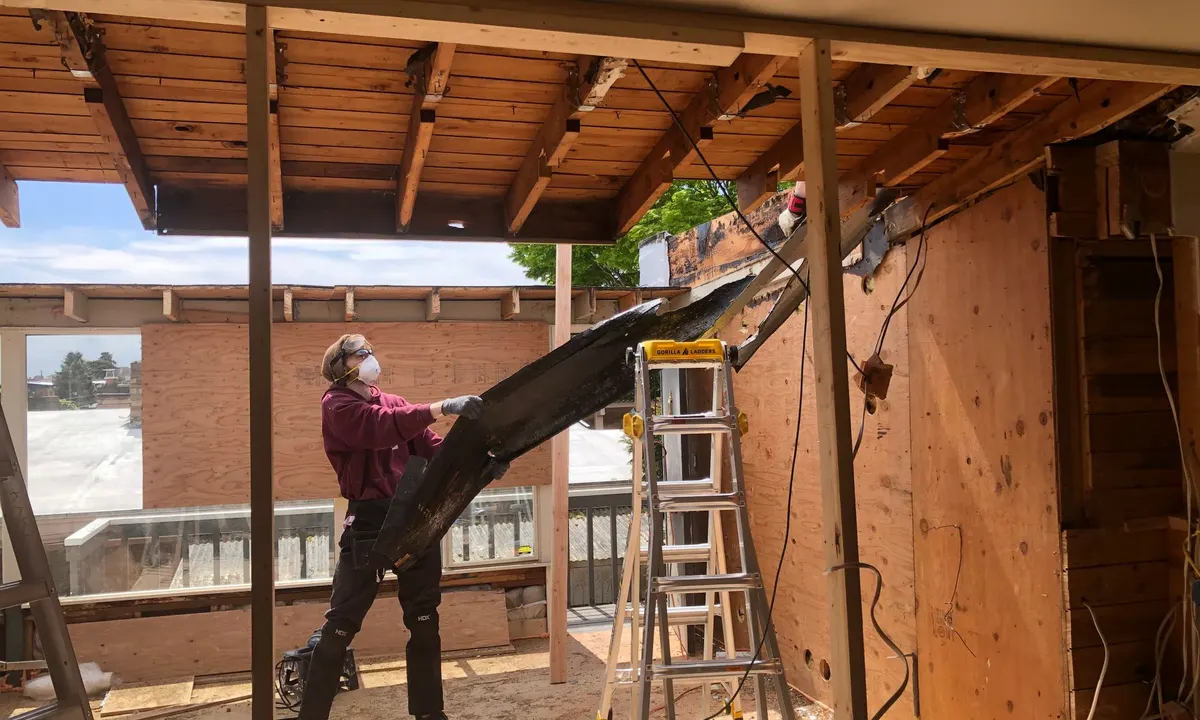
An addition, a pool, a finished basement, or a garage turned into a bedroom can raise your property tax bill. A new roof, fresh paint, or replacement cabinets usually do not, at least not right away. Assessors tax the market value a project adds to the home, not what you paid for it. Many states also exclude repairs, solar panels, and some other upgrades by law. This guide explains what tends to be assessed, how the assessor finds out, when the higher value reaches your bill, and which exemptions you may have to apply for yourself.
The short answer
- Projects that add something usually raise the assessment. That means new square footage, a new building or pool, a new bathroom, or converting unfinished space such as an attic, basement, or garage into living area.
- Like-for-like replacement and upkeep usually do not. Several states say so in their statutes or official guidance: re-roofing, painting, new flooring, and replacing fixtures, cabinets, or appliances.
- The increase is the value added, not the cost. A $35,000 pool might add only $20,000 of market value, and only that $20,000 is assessed.
- Assessment caps generally do not shield new improvements. In Texas, Florida, Michigan, and California, the value of new construction is added on top of the capped value.
- Skipping the permit does not keep work off the roll. Assessors also use aerial imagery, field checks, and sales records, and most states can bill back taxes for years the work was missed.
What usually adds value, and what usually doesn’t
No national rulebook exists, but two states publish unusually detailed lists. In California, the Board of Equalization’s Assessors’ Handbook Section 410, Assessment of Newly Constructed Property (opens in a new tab), sorts common projects into assessable and non-assessable work. In Michigan, MCL 211.27(2) (opens in a new tab) lists residential repairs and replacements that an assessor may not count until the home is sold. Other states’ assessors reach broadly similar results, but check your own state before relying on these examples.
| Usually assessed as new value | Usually not assessed (repair or replacement) |
|---|---|
| Room additions and second stories that add square footage | Replacing the roof covering without changing the pitch |
| An in-ground swimming pool, a detached garage, a guest house, or another new structure | Interior or exterior painting; new wall or floor coverings |
| Adding a bathroom or fireplace; adding central air conditioning | Replacing kitchen cabinets, appliances, or plumbing and light fixtures |
| Converting an attic, basement, or garage into living area | Replacing windows, storm doors, gutters, or a water heater |
| A substantial kitchen remodel that adds built-ins, extends counters, or moves walls | Replacing a furnace with one of the same type; insulating or weatherstripping |
| Upgrading electrical service, for example from 100 to 200 amps (California) | Complete rewiring, or removing partitions to enlarge a room (Michigan list) |
The line between the columns is adding something versus restoring something. California’s Property Tax Rule 463 (opens in a new tab) excludes “normal maintenance and repair,” including painting, replacing roof coverings, and adding aluminum siding. It counts a renovation as new construction only when it adds square footage, adds a new building or pool, or turns the improvement into “the substantial equivalent of a new structure.” Texas Tax Code §23.23(e) (opens in a new tab) says “repairs to or ordinary maintenance of an existing structure or the grounds” are not “new improvements” for the homestead cap. Michigan’s list goes further than most. Its exclusions cover complete rewiring, new surfacing, removing partitions, and a whole-home generator, as long as the work is not part of a structural addition or completion. Michigan’s exclusion lasts only until the house is sold.
Repairs can still matter where values are reassessed often. A home that was run-down and has been fully restored is worth more, and in a state that reappraises at market value every year, the next appraisal may reflect that. What the exclusions above prevent is treating routine upkeep as a new addition.
The assessor taxes value added, not what you spent
An improvement is valued at what it adds to the home’s market value, which can be less, or occasionally more, than its cost. California’s handbook gives a pool example: a pool that cost $35,000 to build but adds $20,000 to market value “should be assessed at its market value of $20,000, rather than the actual construction cost.” The Columbia County, Georgia, tax assessors’ FAQ (opens in a new tab) makes the same point: the effect “depends upon location, market demand and quality of construction. Cost is not always the same as value.” A New York State opinion of counsel (opens in a new tab) adds that some improvements may not change market value at all, such as an ornate garden in an area where basic landscaping is already the norm.
Two consequences follow. First, a project budget is not a good estimate of your new assessment. Second, if the value added on your notice is far above what comparable homes with the same feature sell for, that difference is evidence you can raise in an appeal.
How the assessor finds out
- Building permits. In California, Revenue and Taxation Code §72 (opens in a new tab) requires every agency that issues building permits to send a copy to the county assessor “as soon as possible.” Completion documents must follow within 30 days. Many other states have similar arrangements. The Cook County Assessor (opens in a new tab) says that when it receives building permits, “our staff conduct a field check of the improvement.”
- Aerial and oblique imagery. The Jefferson County, Idaho, Assessor (opens in a new tab) compares historical and current images to identify changes to properties over time. In Texas, the Fort Bend Central Appraisal District (opens in a new tab) said in its imagery request for proposals that oblique photos would help it identify “un-permitted improvements.”
- Field inspections and sales. Idaho’s rules require a field inspection of every property over a five-year cycle. The Placer County, California, Assessor (opens in a new tab) lists permits, ownership transfers, tips from the public, and “routine field checks” as ways new construction is discovered.
Unpermitted work is still taxable, and back taxes can follow
Placer County’s assessor puts it plainly: the assessor “is required to value all new construction, even if a building permit has not been issued.” When an assessor discovers an improvement that was left off the roll, the law in most places allows taxes for earlier years too:
- Texas: under Tax Code §25.21 (opens in a new tab), real property omitted from the roll in any of the three preceding tax years is appraised as of January 1 of each year it was omitted.
- California: escape assessments under Revenue and Taxation Code §§531–532 can generally go back four years after July 1 of the assessment year in which the property escaped.
- Florida: §193.092 (opens in a new tab) limits back assessments to three years. Back taxes do not apply, though, if the owner “complied with all necessary permitting requirements” when the improvement was completed, or voluntarily disclosed it to the property appraiser before January 1 of the year it is first assessed. In Florida, pulling the permit protects you from back taxes even if the appraiser is slow to add the work.
When the higher value reaches your bill
Most states value property as of a single date each year, so timing depends on where the project stood on that date.
- Texas appraises property at market value as of January 1 (§23.01 (opens in a new tab)). Unfinished work can be counted partially. The Collin Central Appraisal District (opens in a new tab) says an improvement is added “at the percent of market value, generally based on completion, as of January 1st.”
- Florida does the opposite. Under §192.042 (opens in a new tab), improvements not substantially completed on January 1 “shall have no value placed thereon.” For homesteads, §193.155(4)(a) (opens in a new tab) adds changes and improvements at just value as of the first January 1 after they are substantially completed.
- California does not wait for the next roll. Completed new construction triggers a supplemental assessment for the rest of the fiscal year, and completion between January 1 and May 31 produces two supplemental bills. Our California supplemental bill guide explains how to read them.
In states that reappraise only every few years, an improvement is still usually added in the year it is discovered or completed. It does not wait for the next revaluation. Ask your assessor how a mid-year project is handled.
Caps don’t cover new improvements
Many homeowners assume their homestead cap limits how much a remodel can add. Generally it doesn’t:
- Texas: the 10 percent homestead limit in §23.23(a) (opens in a new tab) is 110 percent of last year’s appraised value plus “the market value of all new improvements.” Our Texas homestead guide covers the cap in more detail.
- Florida: the Save Our Homes limit keeps applying to the existing home, but changes, additions, and improvements are added at full just value, as above. The 10 percent caps on non-homestead property treat improvements the same way (§193.1554 (opens in a new tab) and §193.1555 (opens in a new tab)). Our Florida homestead guide explains the cap.
- California: under Revenue and Taxation Code §71, the assessor sets a new base-year value “for the portion … which has been newly constructed.” The rest of the property keeps its Prop 13 value. Adding a room does not reassess the whole house. Our Prop 13 guide explains base-year values.
- Michigan: new construction is an “addition” under MCL 211.34d (opens in a new tab). It goes onto taxable value at its full taxable amount (half its true cash value), outside the annual inflation-rate cap.
Worked example: a Texas homestead addition
Hypothetical example (invented numbers, not a real rate for any place): Last year the home was appraised at $300,000. This January the house alone would be worth $340,000 on the market, and a finished addition adds another $60,000, for a total market value of $400,000.
- Cap: $300,000 + 10% ($30,000) + new improvement ($60,000) = $390,000.
- Appraised value: the lower of market value ($400,000) and the cap, so $390,000.
- Without the addition, the appraised value would have been $330,000. The addition raised the taxable base by the full $60,000.
- At a combined rate of 2.0 percent, that is about $1,200 a year. Fixed-dollar exemptions, such as the school homestead exemption, do not shrink this increase.
For other states, multiply the value added by your assessment ratio (for example, 35 percent in Ohio) and by the combined rate. Then check whether a cap or exemption changes the result. Our property tax calculation guide walks through each step.
Upgrades that are exempt or excluded
Some improvements are kept off the bill on purpose. These programs are where an owner most often loses money by not filing.
Solar panels
The Solar Energy Industries Association counts 36 states with property tax exemptions for solar (opens in a new tab), but the rules differ:
- Texas exempts the appraised value that comes from a solar or wind-powered energy device used primarily for on-site energy (Tax Code §11.27 (opens in a new tab)). You must apply. File Form 50-123 (opens in a new tab) with your appraisal district between January 1 and April 30. Once granted, it generally does not have to be refiled each year.
- Florida provides that, for residential property, the just value attributable to a renewable energy source device such as solar panels, inverters, or storage “may not be considered” (§193.624 (opens in a new tab)).
- California excludes active solar energy systems from new construction under Revenue and Taxation Code §73, with no form needed for an owner who adds a system. The exclusion is scheduled to become inoperative on January 1, 2027. The Board of Equalization’s September 2026 letter to assessors (opens in a new tab) says systems that qualify before then stay excluded until the property changes ownership. A bill to extend the exclusion to 2032, AB 2389 (opens in a new tab), was held in committee on May 14, 2026 and did not pass before the 2026 session ended, so the January 1, 2027 date stands. If you are planning a California installation, a system that does not qualify before January 1, 2027 can have its added value assessed as new construction. Ask your county assessor how it treats a project that is underway at year-end. The same letter covers a related change under AB 1516: starting January 1, 2027, the first buyer of a newly built home that came with a qualifying solar system must file the Initial Purchaser Claim (Form BOE-64-SES) within three years of the purchase. A late claim gets the exclusion only from the lien date of the year it is filed.
- New York’s RPTL §487 (opens in a new tab) exempts the added value of solar and other qualifying systems for 15 years. Each county, city, town, village, and school district can opt out, so the exemption may apply to some of your taxes and not others.
- New Jersey exempts the difference in assessed value before and after a certified renewable energy system is installed. You file Form CRES (opens in a new tab) with the municipal tax assessor.
General home-improvement exemptions
- Illinois: the Homestead Improvement Exemption (35 ILCS 200/15-180 (opens in a new tab)) shields up to $75,000 of added fair cash value on an owner-occupied home. It runs for four years after the improvement is completed and occupied, or until the next general assessment, whichever is later. Cook County says “No application is required”; elsewhere, the assessor either notifies you or grants it automatically.
- New York: where a locality has adopted it, RPTL §421-f (opens in a new tab) exempts the added value of a project over $3,000 on a one- or two-family home outside New York City. The exemption starts at 100 percent and declines by 12.5 points a year over eight years, on up to $80,000 of added value. Ordinary maintenance and repairs don’t qualify. You must file Form RP-421-f.
- New Jersey: municipalities may adopt the Five-Year Exemption and Abatement Law by ordinance. It can exempt $5,000, $15,000, or $25,000 of improvement value per dwelling unit on homes at least 20 years old. Apply to the assessor within 30 days of completion.
- Florida: a county may reduce the assessment for living quarters built for a parent or grandparent age 62 or older (§193.703 (opens in a new tab)). The reduction is capped at 20 percent of the improved home’s assessed value, and you apply before March 1.
Safety and accessibility work
California excludes several kinds of work from new construction. These include fire sprinklers and fire-detection systems in an existing building (§74), seismic retrofitting (§74.5), and modifications that make a home more accessible for a severely and permanently disabled resident (§74.3). Rainwater capture systems are also excluded under §74.8. The seismic and accessibility exclusions require you to notify the assessor and file supporting documents, so file when the project is finished. The Sacramento County Assessor (opens in a new tab) notes that these exclusions end when the property changes ownership.
Rebuilding after a fire, flood, or storm
Restoring a damaged home is generally treated differently from improving it. In Texas, a replacement structure for one made uninhabitable by a casualty is not a “new improvement” for the homestead cap, unless it has more square footage or its exterior is of higher-quality construction (§23.23(f) (opens in a new tab)). In Florida, a rebuilt homestead keeps its pre-damage assessed value if it is no more than 130 percent of the original square footage, or 2,000 square feet in total, and work starts within five years (§193.155(4)(b) (opens in a new tab)). California excludes timely reconstruction that is substantially equivalent to what was destroyed. Our disaster relief guide covers the claims to file.
Before you start a project
- Look up your current record. Note the square footage, room counts, and features the assessor already lists, so you can compare later. Our guide to finding your county record shows where to look.
- Ask the assessor how the project will be treated. Ask whether it is assessable, whether partial completion on the valuation date counts, and whether an exemption applies.
- Pull the permit. It is usually required anyway, and in Florida it is what protects you from back taxes.
- Calendar any exemption filing. Texas solar exemptions are due by April 30. New Jersey’s five-year exemption must be filed within 30 days of completion. California’s seismic exclusion needs notice within 30 days and documents within six months.
- Keep the contract, final invoice, and photos. They support an exemption claim and help show the assessor what was a repair and what was an addition.
- Plan for escrow. If your taxes are paid through your mortgage, a higher bill can lead to an escrow shortage. Our escrow shortage guide explains the notice.
If the new value on your notice looks wrong
First check the facts on the record. Square footage, bathroom count, a pool listed as in-ground when it is above-ground, or a project recorded as finished when it wasn’t are factual errors that many offices correct without a formal appeal. Our guide to correcting assessment record errors explains how. If the facts are right but the value added seems too high, compare sales of similar homes with and without the feature, and file an appeal by the deadline on your notice. See what to bring to an assessment appeal and, in Texas, our protest guide.
Frequently asked questions
Does a new roof increase property taxes?
Usually not. Replacing a roof covering is treated as repair or maintenance in many states. California’s Property Tax Rule 463 lists it as normal maintenance, and Michigan’s MCL 211.27(2) excludes it until the home sells. In a state that reappraises at market value every year, though, a fully restored home can still show a higher value at the next appraisal.
Will a kitchen remodel raise my property taxes?
It depends on what changes. Replacing cabinets, appliances, and fixtures is usually not assessed. A remodel that moves walls, adds built-ins, or adds square footage usually is. The increase is the market value the work adds, not what you spent.
Does adding a pool increase property taxes?
Yes, in most places an in-ground pool is a new improvement. It is assessed at the value it adds. California’s handbook gives the example of a $35,000 pool that adds $20,000 of market value and is assessed at $20,000.
Do solar panels raise property taxes?
Often not, if you claim the exemption. Texas requires Form 50-123, New Jersey uses Form CRES, and Florida excludes residential solar value by statute. California’s exclusion ends for systems that do not qualify before January 1, 2027. Systems that qualify before then stay excluded until the property changes ownership.
Can I appeal if my assessment went up after a renovation?
Yes. First check the record for errors such as wrong square footage or a project listed as finished when it wasn’t. If the facts are right but the added value looks too high, compare sales of similar homes and file by the deadline on your notice. Our appeal preparation guide explains what to bring. Also confirm your homestead exemption is still on the record after the work.
Sources reviewed October 16, 2026. This guide summarizes rules in selected states; assessment practices, exemptions, and deadlines vary by state and county, so confirm how your project will be treated with your local assessor or appraisal district.